I may earn a commission at no extra cost to you. #ad
Free Guide: The Essential Steps to Authenticating Physical Gold Bullion
Jump to Section
1. Visual Inspection and Mint Specifications
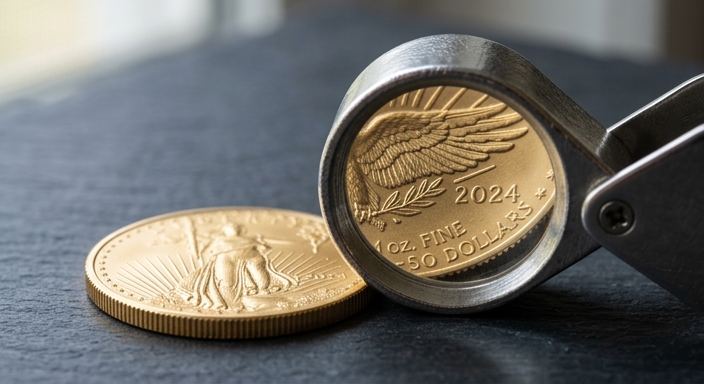
The first step in authenticating gold bullion begins with a keen eye and a magnifying glass (preferably a 10x jeweler’s loupe). Every legitimate sovereign mint—such as the United States Mint, the Royal Canadian Mint, or the Perth Mint—produces coins and bars with exacting standards.
Start by comparing your item against known high-resolution images from the official mint website. Look for sharpness in the relief, the clarity of the lettering, and the consistency of the finish. Counterfeit items often have "mushy" details, uneven borders, or slight variations in the font styles. For gold bars, check the serial numbers and the assay card. Authentic assay cards should have security features like holograms, microprinting, or color-shifting ink.
2. Precise Weight and Dimension Verification
Gold is one of the densest elements on earth. This physical property is your best friend when it comes to authentication. To perform this check, you need a high-precision digital scale (accurate to 0.01g) and a pair of digital calipers.
Look up the official specifications for your coin or bar. For example, a 1 oz Gold American Eagle should weigh 33.931 grams (it contains 1 troy ounce of gold but is 22k, meaning it has additional copper/silver weight). If your coin is the correct diameter and thickness but weighs significantly less than the specification, it is a fake. If it weighs correctly but is thicker or wider than it should be, it likely contains a less dense metal like lead or copper plated in gold.
3. The Resonance (Ping) Test for Coins
The "ping test" is an age-old method used by stackers to identify base metal counterfeits. When struck, gold has a very specific, long-lasting resonant frequency. Base metals like lead or zinc tend to produce a short, dull "clack" rather than a musical "ring."
To perform this safely without damaging the coin, you can balance the coin on the tip of your finger and gently tap it with another coin or a plastic pen. Alternatively, there are mobile apps (like CoinTrust or Precious Metals Verifier) that use your phone’s microphone to analyze the sound frequency and compare it against the known acoustic signature of specific gold coins.
4. Magnetism and Chemical Testing
Gold is non-magnetic (diamagnetic). If you hold a strong neodymium magnet to a gold bar and it sticks—or even shows a slight attraction—the item is counterfeit. However, be aware that many counterfeiters use other non-magnetic metals like lead, copper, or tungsten, so a "pass" on the magnet test does not guarantee authenticity.
Acid testing is another common method, though it is "destructive," meaning it requires scratching the item to test the metal beneath the surface. For bullion coins with premium value, acid testing is generally discouraged. However, for scrap gold or bars where aesthetics are secondary to purity, a 22k or 24k acid kit can provide a quick confirmation of gold content.
5. Advanced Electronic Verification Tools
For serious investors, professional-grade electronic testers are the gold standard. The most popular among dealers is the Sigma Metalytics Precious Metal Verifier (PMV). This device uses electromagnetic waves to measure the resistivity of the metal. Because every metal and alloy has a unique electrical signature, the PMV can "see" through gold plating to detect a tungsten or copper core without damaging the coin.
Another high-end tool is the XRF (X-ray Fluorescence) analyzer. This machine fires X-rays at the item and measures the returning radiation to determine the exact elemental composition of the surface. While highly accurate, XRF machines are expensive and often only found at reputable bullion dealerships or refineries.
6. Common Red Flags of Counterfeit Bullion
Experience is the best teacher, but knowing these common red flags can save you from a costly mistake:
- Too Good to Be True Pricing: If someone is selling gold below the current "spot" price, it is almost certainly a scam.
- Incorrect "Year" Combinations: Some fakes feature designs that weren't minted in the year stamped on the coin.
- Sloppy Reeding: Check the edges of the coin. The ridges (reeding) should be uniform and sharp, not rounded or uneven.
- Incorrect Luster: Real gold has a deep, rich glow. Fakes often look overly "shiny" or have a grayish, oily tint common with gold-plated lead.
7. Frequently Asked Questions
Yes, to an extent. Gold is non-magnetic. If a gold coin or bar is attracted to a magnet, it is definitely not pure gold. However, many non-magnetic metals are also used in counterfeits, so this test is not definitive on its own.
The ping test involves tapping a gold coin and listening to the resonance. Real gold has a long, high-pitched ring, whereas base metals produce a dull 'thud'.
High-end electronic testers like the Sigma Metalytics Precious Metal Verifier are extremely reliable as they use electromagnetic waves to check the metal beneath the surface without damaging the item.
While not 'common' in the sense of everyday transactions, tungsten-filled bars are a known threat because tungsten has a similar density to gold, making weight-based tests alone insufficient.